Remploy
closures "will add misery and heartache to another 2,000
people":
Sean McGovern
Unite NEC Disability rep responds to Breakthrough-UK
23 May Last week
Breakthrough-UK (B-UK) publicly released an email explaining why
they would not put their name to a
letter posted by Inclusion London, and others,
calling for Remploy factories to remain open.
(This letter appeared in the
Guardian on Friday 11th May)

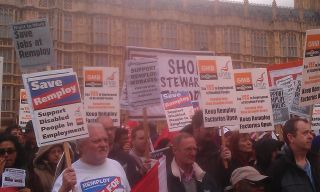
Sean McGovern (centre, wearing scarf)
at Remploy lobby of Parliament
B-UK, while not wishing disabled workers to lose their jobs,
nonetheless proceeded to explain why, for the greater good of
the disability movement, Remploy workers should willingly
surrender to their fate, thus consigning themselves and
'segregated' employment to the footnotes of social history.
B-UK contend: "Firstly, the social context has changed: the
focus now for disabled people – for which we have fought long
and hard – is on rights and independence, on mainstream
employment and inclusive education, on user-led organisations
and organisations controlled by disabled people. We have
rejected segregated provision."
The above statement contradictory. On the one hand it calls for
the mainstreaming of disabled people into employment, while at
the same time promoting user-led organisations controlled by
disabled people.
Which is it? Disabled people should either enter mainstream
employment and be given a fair chance to compete on level terms
(by using means such as Access to Work and reasonable
adjustments) or, we should form user-led organisations which we
control and run.
The idea of disabled people running a company from top to bottom
is great. But, wouldn't this create a more complete disability
'ghetto' (I use this word in honour of Margaret Hodge who first,
charmingly, used this term to describe Remploy factories) than
Remploy? For now you'd not only have disabled workers, but the
managers would also be disabled!
Incidentally, the use of 'segregated' when discussing Remploy's
supported employment model is both provocative and misplaced.
Most people who work are, to a greater or lesser degree,
segregated. The very nature of most work means the individual
has sold their skills/labour to an employer for a given period
of time. During periods of work it is generally accepted that
this is not one's own time. The nature of work, which for a
great many workers takes us away from friends, family, and the
general public, can crudely be defined as segregation.
Remploy factories do not differ in this sense. Indeed, they
replicate workplaces up and down the country in both the private
and public sector. Remploy workers clock-in from 7.30 am to 9
am, depending on the factory and nature of their work. They can
be sacked; and they can invoke grievance procedures against
their employer. They work, mostly, around a 35-hour week; have
progressive holiday and sickness entitlement schemes; and good
health and safety conditions. None of this was gifted to them.
No, their unions organised and fought hard for these terms and
conditions, just as thousands of other workplaces have fought
over the years.
B-UK continue their thesis: "Secondly, the general economic
context is vastly different to that of the immediate post-war
years; the strong manufacturing base that we had, and which
supported the Remploy model, is no longer: it has been replaced
by the service sector and the economy is also rapidly developing
into an IT and communications base. Remploy planning and
development has not really taken account of these changes."
There is grain of truth in B-UK's reasoning here. However,
manufacturing still accounts for 12% GDP (whereas financial
services only account for 9%) employing around 2.2 million
workers.
But, you're right Remploy should have kept up with the markets
and began diversifying 15-20 years ago. They should have looked
to other industries to tap into. Indeed, some factories did
invest in some areas of modern industry such as telesales and
security monitoring.
But we, in the trade union movement, have been complaining to
successive governments that depending on old trades and
businesses was not the way forward for Remploy. Back in 2007 we
even put forward an alternative business plan to Price
Waterhouse Cooper (who were carrying out a Review of Remploy)
that would have better exploited reserved contracts for
supported factories and businesses. Our plan would have brought
down the government subsidy per head in the factories massively;
but, we needed time to make good decades of decay. One union
officer felt that given the right kind of work and some time
Remploy could go it alone without government money!
B-UK then decided to state the obvious, with: "Thirdly, of
course, the current economic climate is dire with ever more
austerity on the horizon, the decimation of welfare support for
disabled people, and rising unemployment for the whole
population. This third factor is often used - misguidedly, we
believe - to justify the current calls to keep Remploy factories
open."
As a trade unionist (misguided if we follow your line) I believe
there is a very good reason to keep Remploy factories open. They
maintain a few thousand disabled people in meaningful
employment. Breakthrough-UK, your way points to despair and
poverty for the overwhelming majority of Remploy workers should
they become unemployed. There is a perversity, almost of a
masochistic nature, in your reasoning around the existence of
Remploy.
If Remploy was a co-operative or social enterprise ran by
disabled workers for disabled workers you would doubtlessly
bestow upon it a mark of approval. Would you then criticise it
for segregating its workforce; or decry the fact that it was
still publicly funded because now local authorities and councils
were handing out subsidies and grants and contracts - where do
you get your funding?
Your idea of handing factories over to User Led Organisations is
not new. When the York factory closed several years ago throwing
54 people out of work; from its ashes rose a co-operative
phoenix. This enterprise is still operating. It employs 3 people
making garden furniture and two others to run the co-op (a buyer
and manager I imagine). Sadly, the co-op is struggling; and I
understand being helped by trade union donations.
Is this the model you think the rest of the Remploy factories
should consider? There is nothing wrong with the concept of
co-ops and social enterprises (except that SE's usually lead to
privatisation, downsizing and a general race to the bottom for
their employees). However, if you hadn't noticed we are in the
middle of a double-dip recession; one that, if we look at what's
happening in mainland Europe (which is like a
'get-out-of-jail-free-card' for this government) could make
things even worse here.
Double-dip recessions, an increase in unemployment and the
slashing of local authority and council budgets to the bone are
hardly conditions conducive to starting up scores of co-ops and
SE's in individual regions or several hundred nationally. Even
if such enterprises were opened, they would still need the life
blood of any business venture, orders in their books. Giving
groups of people £10,000 to start up on their own account may
sound generous; but, in reality it is like putting a band-aid on
a gaping wound.
B-UK goes on to reveal: "This barriers approach, or the social
model, identifies the real problems – barriers and
discrimination - and points the way to real solutions."
At last we arrive at the crux of the matter. Remploy factories
only exist because of societal barriers and discrimination
against disabled people; and the social model of disability will
save the day. Except of course, in the real world the 'social
model', a social policy I wholeheartedly embrace, is always
trumped by its bigger bullying brother the 'economic model' .
Finally B-UK, I see by your statistics that you supported 43
people into paid employment last year. Well done. From my
experiences I am willing to bet the people you helped into
employment were well educated and relatively young. In order for
the nearly 2,000 unemployed Remploy workers to be re-employed it
would take 46 B-UKs, as well as a mountain of employer prejudice
to shift.
If the government figures of 1.2 million unemployed disabled
people wishing to work are true, then I ask you Breakthrough-UK
how exactly you think adding another two-thousand people to the
queue will do anything but add misery and heartache to another
2,000 people, their families and friends. Not to forget the
economic impact of another 2,000 wage packets no longer
contributing to the Treasury and local economies. Do you think
that the social model of disability will somehow bring down this
regime that purports to govern us?
Do you suppose Iain Duncan-Smith is going to sometime soon have
an epiphany that causes him to embrace the social model? At what
point in our troubled history do you think employers will banish
disability discrimination from their recruitment processes and
open the door to us?
In the struggle
Seán McGovern
Unite the Union Disability Executive Rep


